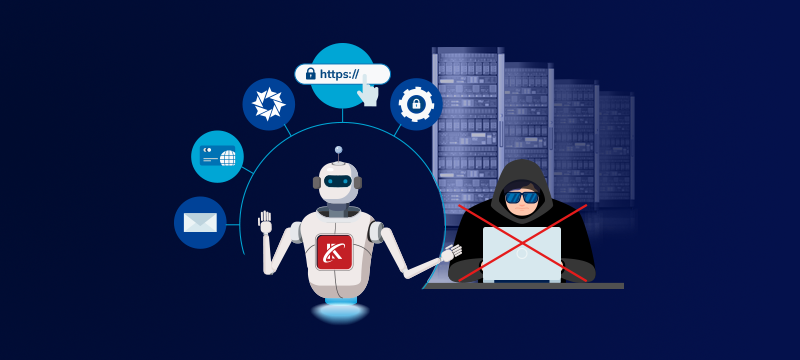
It’s not only businesses that are embracing AI technology; cybercriminals are too, and with increasing sophistication. Today, they use it to automate attacks, create highly convincing phishing campaigns and avoid detection. As these threats become more advanced, traditional security measures struggle to detect them. In this post, we explore how AI is changing the nature of cyberattacks and the new tools that are being used to protect against them.
Contents
How cybercriminals are using AI
AI helps attackers to scale their operations and make them more effective. Here are the main ways it is currently being used:
- Phishing and social engineering: Today, hackers use AI tools, like ChatGPT, to generate malicious emails, texts or chat messages. These tools can imitate people’s writing styles and incorporate information from company websites or social media profiles, which make them highly personalised and convincing.Moreover, AI tools enable these messages to be generated at speed, while eradicating the poor language that was once a clear signal of a phishing scam. According to DeepStrike, AI phishing attacks have increased 4,000% since 2022.
Make sure your staff know the Tell-Tale Signs of a Phishing Email
- Deepfakes and impersonation: Cybercriminals are increasingly using AI to create fake voice recordings and even videos that mimic company bosses, colleagues and clients. These are used to trick staff into transferring money, giving away important business information or revealing login credentials. According to CrowdStrike, there was a 442% rise in AI voice phishing attacks between the first and second halves of 2024.
- Adaptive malware: Some malware now uses AI to adapt its behaviour in real-time to avoid detection and automate attacks. This includes changing its code, running only at certain times, or hiding within memory. This type of malware is being used to research business systems and identify valuable data before carrying out attacks. It’s often used as part of a ransomware attack.
- Automated vulnerability scanning: Cybercriminals use AI to quickly and accurately scan websites and servers for vulnerabilities. This enables the attackers to strike before security has been updated.
- Targeting security tools: An evolving AI threat is adversarial machine learning. Attackers use this technology to confuse or disable security tools by feeding them misleading data or fooling them into classifying a malicious input as safe.
Why traditional defences are no longer enough
Typically, many traditional security tools work by spotting known patterns. For example, antivirus software looks for malware signatures while spam filters use keyword rules. AI-powered threats can evade these tools by constantly adapting, behaving differently to known patterns and learning from failed attacks.
With some threats appearing legitimate and others bypassing security checks, this makes attacks much harder for older tools to predict or proactively block. The best defences against AI attacks are tools that themselves make use of AI to detect suspicious behaviour and automate responses.
How to defend against AI-powered cyberattacks
Keeping your website and data protected from these types of cyberattacks calls for smarter, real-time security. Here are some of the latest tools and best practices that are currently used to detect and respond to AI threats:
- Imunify360: An advanced security suite designed for Linux-based hosting, Imunify360 uses AI to provide six layers of protection. These include a web application firewall (WAF), proactive malware scanning, real-time behaviour checks, intrusion prevention, malicious code removal, and live patching with KernelCare. Crucially, it doesn’t just rely on existing databases of known threats; it also monitors activity and blocks all suspicious actions, helping defend against emerging and zero-day threats too.
- SpamExperts: Many AI-driven attacks are launched via email. SpamExperts is an email filtering tool that uses self-learning technology to detect and block phishing, spoofing and malware. It learns from millions of emails daily and shares that data across all users to stop new attacks as they emerge.
- Real-time activity monitoring: Tools that track login locations, file changes or data transfers can spot unusual patterns. For example, a login attempt from a different country at an unusual hour might trigger an alert.
- Live patching and hardened PHP: Even small vulnerabilities can be exploited. Tools like KernelCare and hardened PHP, included in Imunify360, keep systems updated without needing downtime. This removes the vulnerabilities that AI malware seeks out when looking for ways to attack.
Discover why Imunify360 is The Most Effective Security Tool for Linux Servers
Additional security measures
While AI tools play a leading role, other protections are also essential. These include:
- SSL certificates: These encrypt data moving between your website and users, making it harder for attackers to steal logins or payment details. Email SSLs offer the same protection for email communication. AI tools are incapable of accessing encrypted data in real-time.
- Enterprise-grade firewalls: Larger businesses with more complex systems can benefit from next-generation firewalls like FortiGate. These advanced systems use AI and ML for real-time threat detection and response, including protection against malware, ransomware and zero-day attacks.
- Staff awareness and training: Many AI-powered attacks trick users into clicking links or sharing sensitive information. This makes it vital that staff are trained to spot AI-generated phishing attacks, including newer techniques like deepfakes.
Find out more about why training is essential, read: How Human Error Can Jeopardise Cybersecurity
Conclusion
As AI evolves, cybercriminals will continue to make greater use of it. Today, it is used to create everything from highly convincing phishing attacks to sophisticated malware that can learn to avoid detection. As traditional security tools were not designed to tackle these types of threats, keeping your website protected means adopting more advanced tools that combine AI, behaviour tracking and real-time monitoring and response.
At Webhosting UK, we utilise the latest security tools and best practices to defend our clients’ systems from attacks. In addition, we also offer optional solutions, including Imunify360, FortiGate Firewalls and SpamExperts. Click on the links for more information.