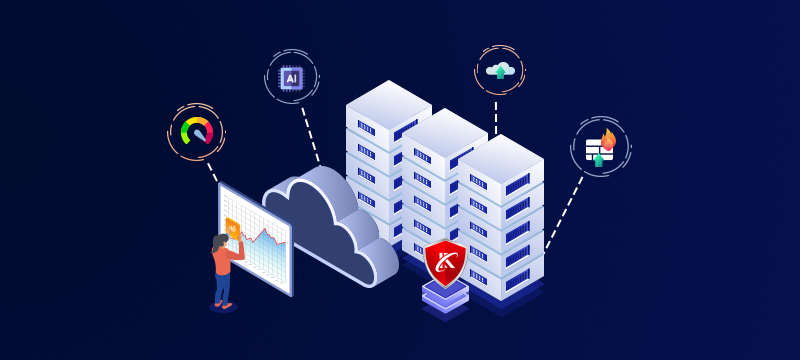
While many organisations rely on the cloud to run critical workloads, rising costs, evolving threats and the need to run AI workloads are making them reconsider their approach to cloud adoption. In this post, we examine how SMEs and enterprises are rethinking the selection, structuring and governance of cloud services in order to protect data, improve cost control and deliver consistent performance.
Contents
Why cloud strategies need rethinking
Cloud adoption has increased dramatically over the past decade, with many businesses using it to reduce capital investment on infrastructure, improve scalability and enable faster deployment and digital transformation. While this has been beneficial, it has also created environments that are fragmented, difficult to manage and costly to run.
As cloud usage has evolved, many early adoption decisions made by organisations no longer meet today’s needs. With higher performance expectations, more sophisticated security threats, and closer scrutiny of cloud spending, businesses are reassessing their cloud strategies to tighten control, improve consistency and ensure long-term operational sustainability.
From cloud-first to value-driven decisions
The trend of moving everything to the cloud is increasingly being challenged. Instead, businesses are being more selective, focusing on where the cloud meets objectives and delivers real value. This means they are also looking at whether alternative models may be more suitable.
For SMEs, the value of using the cloud often comes from its simplicity and reliability. For instance, a managed cloud platform that reduces day-to-day administration, provides predictable performance, and includes built-in resilience through redundancy, backups and scaling, allows smaller teams to operate effectively without needing infrastructure know-how.
For enterprises, the challenge is different. With many already operating large cloud environments, often using multiple providers, key considerations include identifying those workloads that benefit from flexible capacity and those which are better suited to the private cloud, VPS or dedicated servers. Influential factors here include performance, cost and regulatory requirements.
Considering other options? Read: The Case for Hybrid Hosting: Combining Cloud Flexibility with Dedicated Power
AI is reshaping cloud requirements
The growing use of AI and automation is now influencing how cloud environments are designed. AI workloads require scalable compute capacity, fast storage and the ability to process large volumes of data in near real time.
SMEs often adopt AI through cloud-based, software as a service (SaaS) tools, such as customer support platforms (e.g. Zendesk), analytics services (e.g. Tableau) and marketing automation (e.g. HubSpot). To ensure these operate effectively, businesses require hosting environments that can handle variable demand while ensuring consistent responsiveness.
Enterprises, meanwhile, tend to integrate AI more deeply into their operations, for instance, for forecasting, fraud detection, optimisation and decision-making. This puts continual demand on infrastructure and near real-time data movement, increasing the need for cloud-environments that offer flexible capacity and integration.
Put your cloud move on the right track, read: A Multi-Faceted Approach to Successful Cloud Adoption for Your Business
Security as a core architectural concern
Security remains a key concern for cloud adoption. Today, the main cloud-related security issues are not caused by vulnerable infrastructure, but by compromised identities, poor access control and misconfigurations. A key concern for businesses, therefore, is whether a cloud environment is designed and managed correctly.
This change in approach to security is a result of a change in cybercriminal tactics. Instead of trying to breach network defences, attackers are increasingly targeting user credentials, access permissions and account behaviour. This means that aside from perimeter-focused security, businesses are now putting greater emphasis on controls that continuously verify and tightly manage access and permissions.
For SMEs, this will likely mean relying on the managed security features that are built into cloud platforms – an approach that reduces the burden of implementing and managing complex security tools in-house. Enterprises will need a more layered approach, combining identity controls with continuous monitoring and automated response across larger environments.
Important for both types of businesses, however, is that cloud security should now be seen as a central part of system design, not something to add on later.
Keep informed about the latest threats, read: AI-Powered Hacking: The New Frontier of Cybersecurity
Financial accountability and cost discipline
Cloud cost control has become increasingly complex. As environments grow, businesses are finding that unused resources, inefficient configurations and duplicated services are increasing their spending. The issue can be even more challenging when workloads are spread across multiple providers.
Without clear visibility into usage, businesses can see cloud costs rise rapidly. An effective solution for many smaller businesses is to opt for managed cloud services that offer clearer pricing models and built-in controls that limit waste.
Enterprises face the same challenges, but on a much larger scale. With cloud budgets often spread across multiple teams and departments, ownership is harder to define. To keep spending under control, organisations are placing greater importance on cost management, including tracking usage more closely, assigning responsibility and using automation to optimise consumption.
Shared pressures, different responses
While SMEs and enterprises operate at different scales, they face similar challenges with cloud adoption. Performance expectations continue to rise, security threats are evolving, AI workloads are becoming more common and financial oversight is tightening.
The key difference is in how the two types of organisations respond. For SMEs with smaller in-house teams and limited expertise, prioritising simplicity, reliability and access to support can be the most effective route. With enterprises, in contrast, focus is more on governance, integration and flexibility across complex environments.
Key takeaways
- Cloud adoption is an ongoing process, not a one-off task
- Value-driven decisions are replacing cloud-first thinking
- AI workloads are reshaping modern infrastructure requirements
- Identity-focused security has become essential
- Cost visibility and accountability are now critical
Conclusion
Cloud platforms play a central role in modern organisations; however, their value depends on maintaining control over performance, security and costs. When rethinking cloud adoption, both SMEs and enterprises should reconsider previous decisions to ensure their cloud environments meet today’s operational, AI and financial demands.
Looking for a managed cloud platform that offers the security, uptime, performance, scalability and support modern organisations need? For more information, visit our Enterprise Cloud Server Hosting page.