While featured snippets have long been a way to help websites increase visibility, the rise of AI search has made them even more important today. Used to provide searchers with quick answers, they can enhance brand identity and drive meaningful clicks when traditional clickthrough rates are on the decline. In this post, we explain why snippets still matter and provide guidance on creating content that gets featured.
Contents
What are featured snippets?
Featured snippets are short extracts that are displayed at the top of Google search results. Their purpose is to save users time and effort by providing them with an instant answer, rather than requiring them to scroll through results and sift through content.
Displayed as either a succinct paragraph, a step-by-step list, or a comparison table, snippets are generally selected from web pages that Google finds relevant, authoritative and well-structured.
Their prominent position at the top of the results page, together with the source’s page title and link, boosts brand visibility and increases the likelihood of a clickthrough.
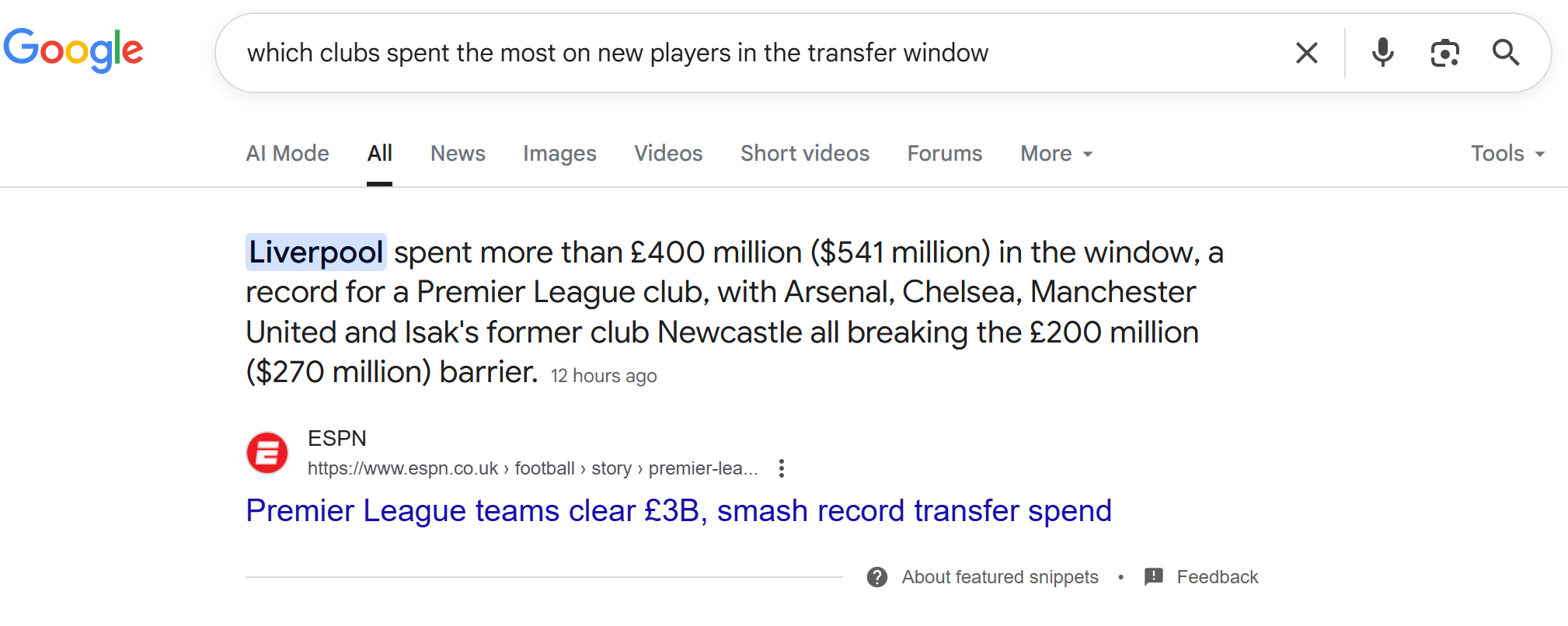
Snippets vs AI Overviews
While AI Overviews also provide direct answers at the top of results pages, these are often much longer than a snippet. This detail means user queries are often fully answered; by comparison, the shorter answer provided by a snippet encourages more people to click through to the cited website.
Another difference is that snippets are taken from a single website, and AI Overviews are generated by pulling together information from a range of sites. Overviews, therefore, offer users more links to choose from, reducing the likelihood of a clickthrough compared to a snippet.
For more information, read: How Google AI Overviews Affect Website Traffic
Formats that work best
One of the biggest advantages of snippets over AI Overviews is that you can structure your content in a way that makes it more likely to be displayed as a snippet, whereas you cannot control how Google’s AI will paraphrase your content in an Overview.
Google is more likely to extract content that follows a clear, predictable format. The three main types of snippets are:
- Definition paragraphs
These are used to answer ‘What is’ or ‘Why’ questions. To create content used in definition paragraphs, provide a succinct title with an H2 or H3 heading and keep the definition to around 40–50 words. This is long enough to provide a clear answer while short enough to fit the snippet box.Make sure the content answers the query, includes the keyword and provides relevant context. - Numbered or bulleted lists
List snippets are used for providing users with step-by-step tasks or ranked recommendations. When optimising these for use in a snippet, make sure each point is written as a short, action-focused line. For example:- Download the WordPress package.
- Upload the files to your hosting account.
- Create a MySQL database.
- Run the installation script.
This format makes it easy for Google to extract, while its brevity encourages users to click through for more detailed instructions.
- Tables
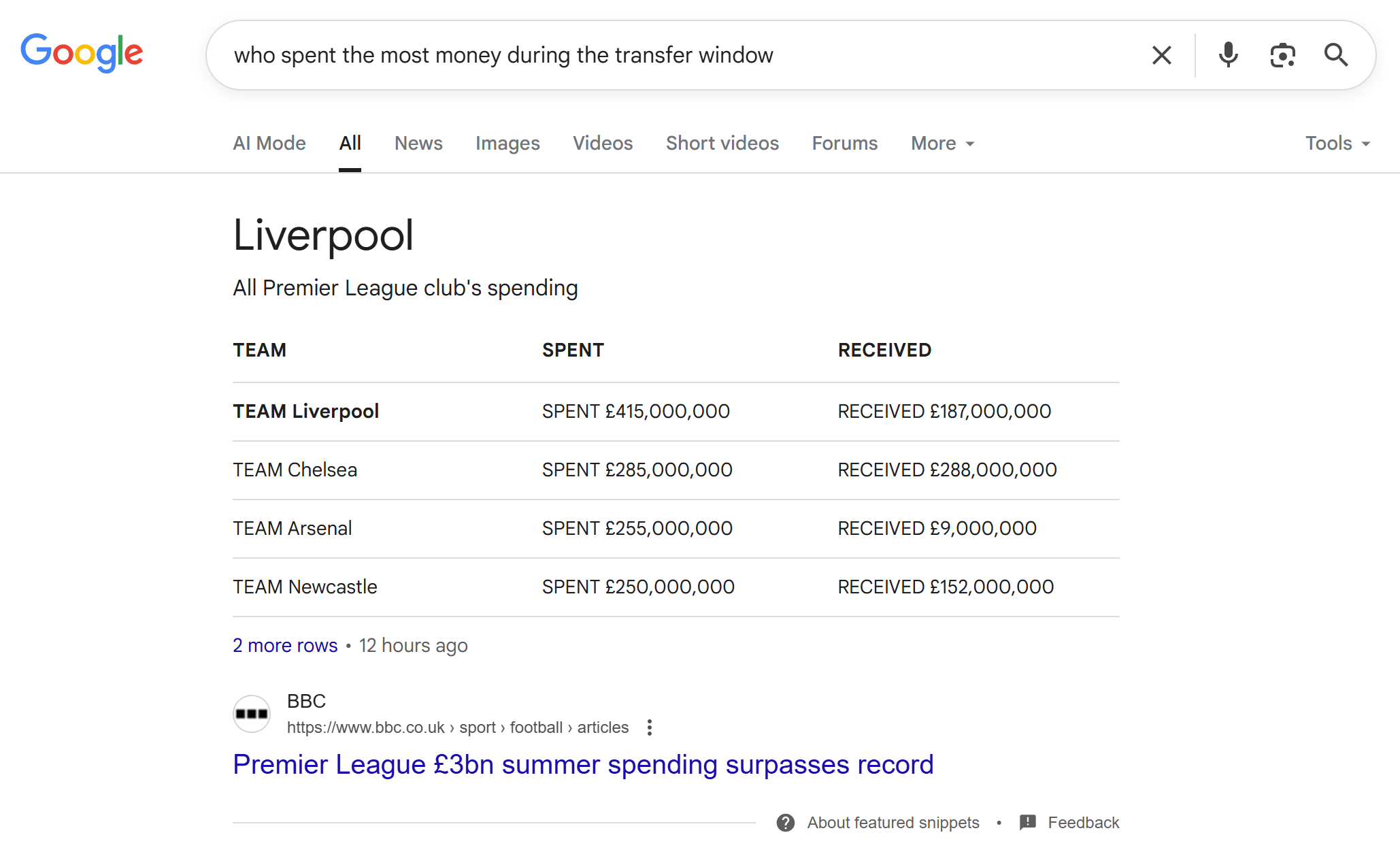
Tables are ideal for comparison queries. For instance, when Google was asked, ‘Who spent the most money during the transfer window?’ the result shown was:
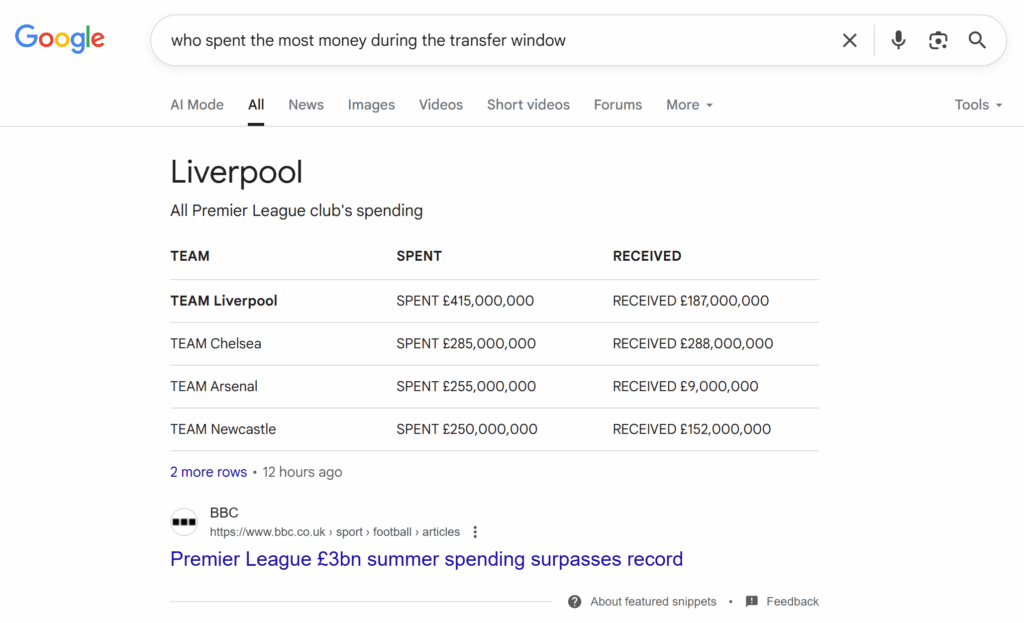 This chart format is simple to understand but also entices users to visit the website for a fuller comparison.
How to optimise for snippets
While formatting is important, Google will also consider other criteria, such as clarity, structure, and trustworthiness, before using your content in a snippet. Here are some key tips for optimising your content:
- Write with clarity
Always put the answer in the first sentence, immediately after the heading. You can then add more detail in the following sentences. - Use question-style headings
Your headings should mirror the questions people use when they search. For instance, instead of the title ‘Benefits of SSL certificates,’ write ‘What are the benefits of SSL certificates?’ This makes your content better match the query when Google is looking for the best answer. - Structure content logicallyAs Google prefers answers that are easy to skim, you should divide content into clearly defined sections that address a single point. Each section should have a short, relevant heading.
- Add FAQ schem
If you have FAQ content, using schema markup helps Google recognise it. This increases the likelihood of being cited not just in snippets but also in People Also Ask boxes. - Reinforce EEAT
Experience, Expertise, Authoritativeness, and Trustworthiness (EEAT) are criteria that Google uses to assess content quality when looking for sites from which to extract snippets. To demonstrate EEAT, make sure that authors are named, sources are cited and provide examples of real-world experience or evidence. - Focus on helpfulness
According to Google’s John Mueller, the search engine prefers to cite unique content that is genuinely helpful to users rather than that which is written to meet the needs of algorithms. Helpfulness is therefore more important than SEO.
Why hosting performance matters
User experience is another factor that Google takes into consideration when selecting snippets. If users click through, it wants them to visit pages with high Core Web Vitals scores that load quickly and perform reliably.
Your choice of web hosting solution can have a significant effect on performance and other key factors, like security. For instance:
- Speed: SSD and NVMe-powered servers cut latency and reduce loading times.
- Reliability: Uptimes of 99.9% or more ensure your pages are always available for crawling.
- Security: SSL certificates and firewalls show Google your site is trustworthy, improving your chances of being cited.
Considering NVMe? Read: What Makes NVMe Hosting a Game-Changer for High-Traffic Websites
Conclusion
The growing use of AI in search means websites are winning far fewer clicks from Google. As a result, appearing in a featured snippet is now a key way to make your brand stand out and attract traffic. By writing succinct definitions, step-by-step guides and comparison tables, together with a focus on EEAT and website performance, you can increase your content’s chances of being used in a snippet.
Key takeaways
- Featured snippets differ from AI Overviews in format, control and click potential.
- Snippets generate higher-quality visits because they link directly to one site.
- Google displays snippets for concise, fact-based queries; Overviews appear for broader topics.
- Definitions, lists and tables are the formats most likely to be extracted.
- Optimisation involves clarity, question-style headings, schema and evidence of EEAT.
- Hosting performance underpins snippet eligibility, with speed, uptime and security all critical.
Looking for fast, reliable and secure hosting that improves your content’s likelihood of being cited? With 99.9% guaranteed uptime, SSD and Intel Xeon-powered servers, free SSLs and a suite of security tools to defend your site, check out our Shared Linux Web Hosting with cPanel plans.