
For shared hosting users, slower performance during busy periods, unexplained errors, and hosting limits that get in the way are often the first signs of a problem, especially when these issues become persistent. In this post, we explain the key signs that indicate when a website has outgrown shared hosting and would benefit from moving to a virtual private server (VPS).
Contents
Shared hosting vs VPS in practice
If you are considering VPS hosting, it’s important to understand how it differs from shared hosting in practice. With shared hosting, your website is one of many that share the CPU, memory and storage resources of a single server. While this helps to keep costs down, it means your site’s performance and stability can fluctuate depending on how busy the other websites are.
With VPS hosting, although your site still uses shared physical infrastructure, it is allocated its own dedicated resources. Unaffected by other sites’ operations, this means more predictable performance, greater flexibility and improved reliability as your site’s demands increase.
Key warning signs that shared hosting is no longer enough
- Slow performance despite optimisation
You may have optimised your website by compressing images, enabling caching and removing unnecessary plugins, yet performance still feels inconsistent during busier periods.When optimisation no longer delivers reliable improvements in performance, this usually indicates a limitation with your shared hosting rather than problems with the site.Need help with optimisation? Read: How to Speed Up Shared Hosting Websites
- Errors or instability during peak traffic
If your site works as expected during normal traffic but you see 503 errors, time-outs or brief periods of unavailability during promotions or traffic spikes, the issue is more likely to be with your server than your website.With shared hosting, providers set limits on how much processing power and how many simultaneous requests each site can handle to prevent server instability. If traffic increases and those limits are reached, requests may be delayed or rejected, resulting in the errors mentioned above.With VPS hosting, your site has greater processing capacity and can handle more simultaneous requests. This reduces the risk of errors and allows the site to remain functional and accessible during busy periods. - Increasing security requirements
If your website starts to process payments, manage user accounts or handle sensitive customer data, security and regulatory compliance will be key priorities.While shared hosting often comes with provider-managed protection, the fact that your site shares a server with many others limits how much control you have over its security. This can be a concern if you start to handle more sensitive data and need to implement custom security measures.With VPS hosting, your site runs in an isolated server environment, protecting it from cross-contamination from other sites and giving you greater control over how you manage security.Looking to boost your defences? Read: Essential Security Measures to Protect Your Digital Operations
- Hosting restrictions are blocking development
To ensure all websites can use a shared server safely, hosting providers put restrictions in place that can prevent you from installing specific software, running background processes or configuring your site as needed. This limits flexibility and can interfere with the ongoing development of your website.By allowing administrative root access to the server, a VPS removes many of these constraints, giving you greater control over the software you can install, the processes you run and how your site is configured. As a result, your website can be developed to meet your needs and goals without unwanted restrictions.Find out more, read: The Benefits of Full Root Access
- Performance vs predictability
If you use shared hosting and your site loads quickly when traffic is low but slows down or behaves inconsistently as more people visit, the issue is not speed but reliability.Moving to VPS hosting often improves speed because your site is no longer competing with others for processing resources. Some VPS plans also use NVMe storage and high-frequency CPUs, which means data is read and processed more quickly. This helps pages to load faster and requests to be completed more efficiently as activity increases.More importantly, performance becomes consistent as visitor numbers rise. Pages load at similar speeds during busy periods, giving you confidence that the site will continue to work as expected when demand increases.
Why timing matters
Once your site has begun experiencing errors or sluggish performance, leaving an upgrade until after a campaign or seasonal peak can be a risky approach. In practice, this can result in failed checkouts, customer login time-outs, and even crashes when your business least needs it. Attempting to upgrade during busy periods can also be disruptive.
By upgrading before you expect increased demand, you give your site the stability it needs to cope with higher traffic. This reduces the likelihood of disruption while ensuring customers receive a reliable experience no matter when they visit.
Before you upgrade
Upgrading to VPS is not necessarily the right choice for every site. Before deciding, it’s worth checking whether the issues you are seeing are persistent and predictable.
If performance problems are infrequent, resolve quickly and are not linked to increased traffic or activity, site optimisation may still be the appropriate route. However, if issues tend to appear when the site is busy or demand increases, this points to a hosting limitation rather than a problem with the site itself.
Understanding where the problem lies helps ensure that moving to VPS is the right choice to address the issues. Furthermore, VPS hosting also gives you room to scale. As traffic, features or workloads continue to grow, you can increase resources without needing to rebuild or migrate your site.
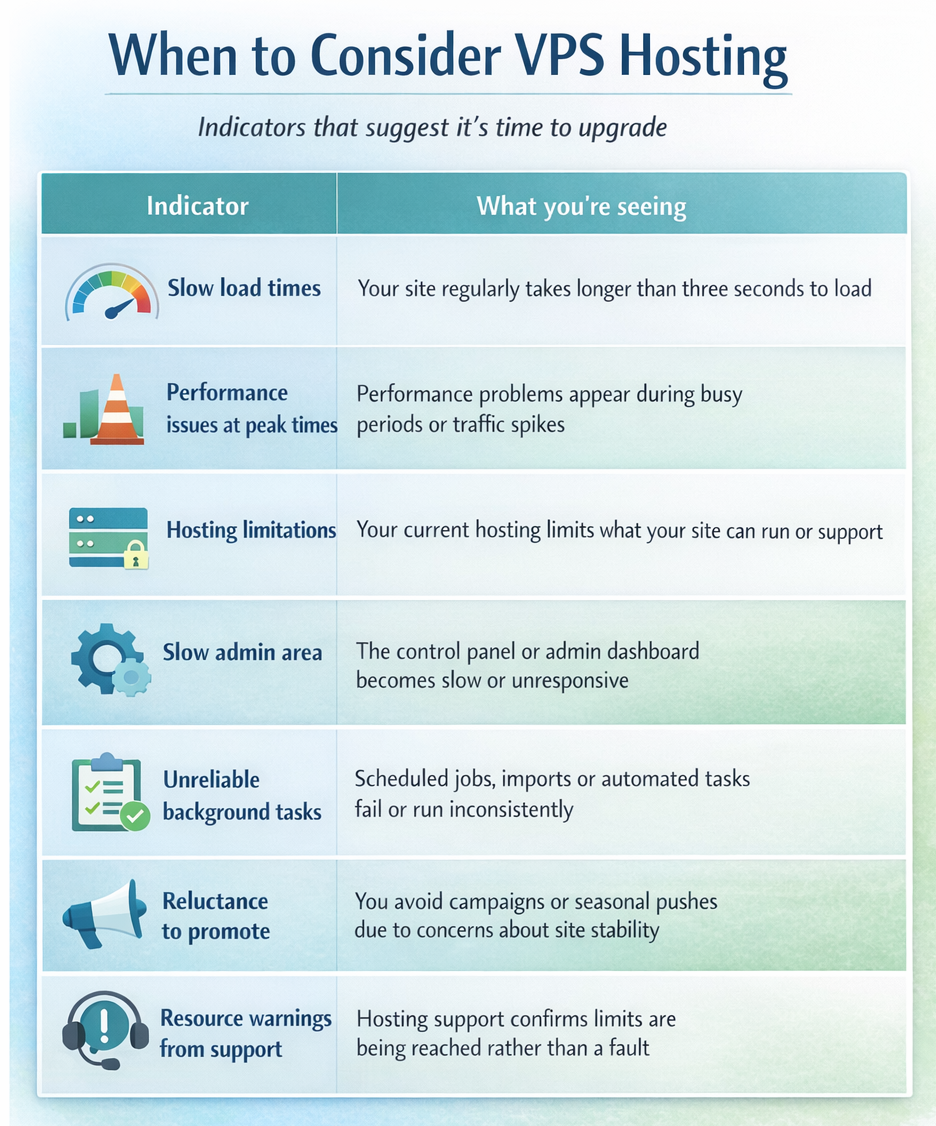
A decision checklist
Key takeaways
- With shared hosting, resources are shared, and performance can fluctuate
- Problems tend to appear gradually as sites grow
- Performance predictability becomes more important than raw speed
- VPS hosting provides consistency, control and scalability
- Upgrading before peak demand can help reduce operational risk
Conclusion
If shared hosting is causing instability, holding back development or creating uncertainty during busy periods, it is no longer meeting your needs. VPS hosting addresses these issues by offering more consistent performance, greater control and the ability to scale without disruption. By upgrading at the right time, you can create a more reliable website that supports continued growth and delivers a better user experience.
Is your website struggling during busy periods? At Webhosting UK, our VPS hosting is designed to deliver reliable performance, greater control and room to scale for growing websites. Visit our VPS Hosting page to learn more.