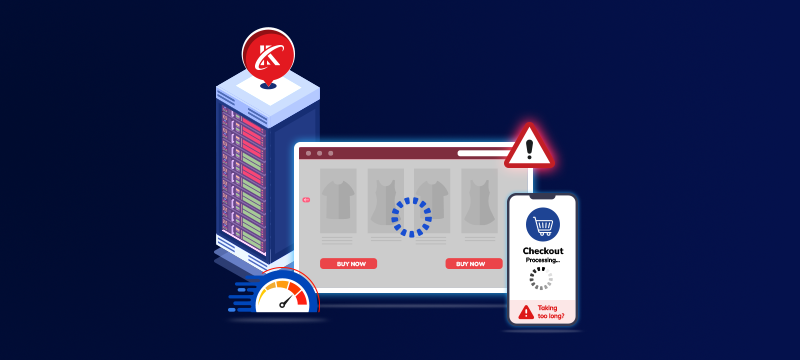
Most growing websites do not fail suddenly. The signs often appear much earlier. A lagging WordPress dashboard, a checkout that slows during busy periods or plugin updates that cause unexpected problems may initially seem like minor inconveniences. The issue is that businesses often tolerate these signs because the site still technically works. These website performance issues are, however, early warnings that the site may now need more reliable hosting.
Contents
Performance problems usually start gradually
While performance problems can eventually lead to more serious issues, they usually begin with inconsistency. Typical signs include fluctuating page load times, admin areas becoming less responsive as more people log in, and WooCommerce stores that become sluggish during promotions or seasonal traffic spikes.
Performance inconsistency is damaging for businesses because it makes the website unpredictable and harder to plan around. This can leave teams unsure whether the problem is caused by the website itself, a recent update, a traffic spike or the hosting environment. Customers, meanwhile, only see the result: delayed pages, slow checkouts or failed actions.
An issue for growing websites is that the more products, orders, customer records, plugins and integrations the website needs to handle, the greater the pressure on the hosting environment. While these may not cause obvious problems on their own, combined, they can make the site less stable, especially during busy periods.
Not every performance issue means the hosting needs to change. However, for business-critical websites, repeated instability during busy periods signals that the current setup should be reviewed. For WordPress and WooCommerce sites, this may mean checking whether existing WordPress hosting still suits the site’s size and workload. Revenue-generating sites need steady performance because delays affect customers, staff, and sales simultaneously.
Support expectations change as websites grow
Expectations around technical support often change as a website grows. While a delayed response may be a minor inconvenience for a non-critical site, it can be an urgent matter for businesses whose websites generate revenue.
The more a business relies on its site for leads, bookings, orders and customer communication, the less it can tolerate slow ticket responses, chatbot frustration or having to repeat issues to multiple agents before someone finally understands the problem.
This does not mean the original hosting was necessarily poor. Rather, the website may have outgrown the level of support and resources available. The key change is one of commercial pressure.
While small sites may accept a wait of several hours, those that take orders, run campaigns or support paying customers cannot afford delays. For these businesses, downtime is commercially stressful and urgent problems need fast answers. This means having agents who can understand the issue, assess the likely cause and guide them towards a realistic fix.
Over time, the need for prompt, human support and practical technical help becomes more important. Without them, staff lose time, customers lose confidence, and the business has less control over the situation. This is why hosting support should be reviewed as the website grows, especially for businesses whose site is critical to their operations.
Backups are often ignored until recovery is needed
Backups can be easy to overlook. When everything is working, they stop being a priority, and many businesses simply assume they are being handled properly, especially when included in the business hosting plan. It is only when recovery is needed that problems become obvious.
A failed plugin update, corrupted database, malware infection or accidental deletion can all make backups an operational priority. It is usually at this point that important questions arise: Is there a recent backup? Does it include the files and database? How long will restoration take? Can the site be rolled back without losing important orders, enquiries or content changes?
When there is uncertainty around backups, recovery can be stressful. Incomplete backups, unclear backup frequencies, poor retention policies and slow restore processes all make incidents harder to manage and resolve. This is where managed hosting can make backups and restores easier to handle.
The issue is not whether backups exist, but whether they are usable and fit for purpose. Growing websites need to understand their backup arrangements from the outset. This means knowing exactly what is backed up, how often backups take place and how quickly a site can be restored and back online.
Why growing websites often delay changing hosting too long
Many businesses stay with unsuitable hosting for longer than they should because the prospect of moving feels risky. While the current setup may not be ideal, businesses stick with it because “it mostly works.”
When a business is dealing with growth elsewhere, website migration can feel like yet another problem to manage. There may also be concern about downtime, email disruption, broken settings, missing files or the time needed to coordinate the move. Moreover, if the website is already busy, the idea of changing hosting can seem more disruptive than coping with existing frustrations.
Familiarity can be another obstacle. If staff know the existing control panel, developers know the current environment, and the business has learned to work around its limitations, moving somewhere less familiar can create apprehension.
However, if moving feels risky, staying put can be risky too. This is especially true when website downtime, slow support and unclear recovery arrangements are already creating friction. As the business grows, existing hosting issues can become more expensive over time. Slow support, unstable performance and unclear recovery setups can all create day-to-day friction. The site may continue operating, but it will take more and more effort to keep it that way.
What matters is that hosting fits how the website is used today, not when first launched. This means that hosting plans designed for small or early websites may no longer be suitable when current traffic levels, content, orders and customer expectations are taken into consideration.
Website warning signs checklist
It may be time to review your hosting if:
- Admin areas become less responsive as more people log in
- WordPress and WooCommerce sites slow during promotions or seasonal traffic spikes
- Hosting support takes longer than expected when an issue is urgent
- Plugin updates create problems that are harder to resolve than they should be
- There is uncertainty about what is backed up, how often backups run or how quickly the site can be restored
- Staff have to work around recurring website issues rather than getting them properly fixed
- Website migration feels risky, even though the current hosting is already creating day-to-day friction
These signs do not always mean that a move is needed straight away. They do, however, suggest that the website may be starting to outgrow the hosting behind it.
Conclusion
Growing websites usually require more from their hosting plan than they did at launch. Performance needs to be more consistent, support more useful, backup arrangements clearer, and the hosting environment needs to cope with the way the site is used today.
If these hosting issues are allowed to persist, friction will increase even if the website still continues to function. For businesses that depend on their websites for leads, bookings, orders or customer communication, reliable hosting provides greater operational confidence, fewer avoidable disruptions and a more stable platform for future growth.
Is your hosting still right for your website?
If your website has experienced significant growth over the last few years, it may be worth reviewing whether your hosting still fits.
Webhosting UK’s VPS Hosting provides the performance, control and scalability growing websites need, with 24/7 support to help keep your site stable as demand increases. For WordPress sites, our managed WordPress Hosting provides a more dependable platform for growth, while Cloud Hosting offers added resilience for businesses with more demanding uptime needs.